

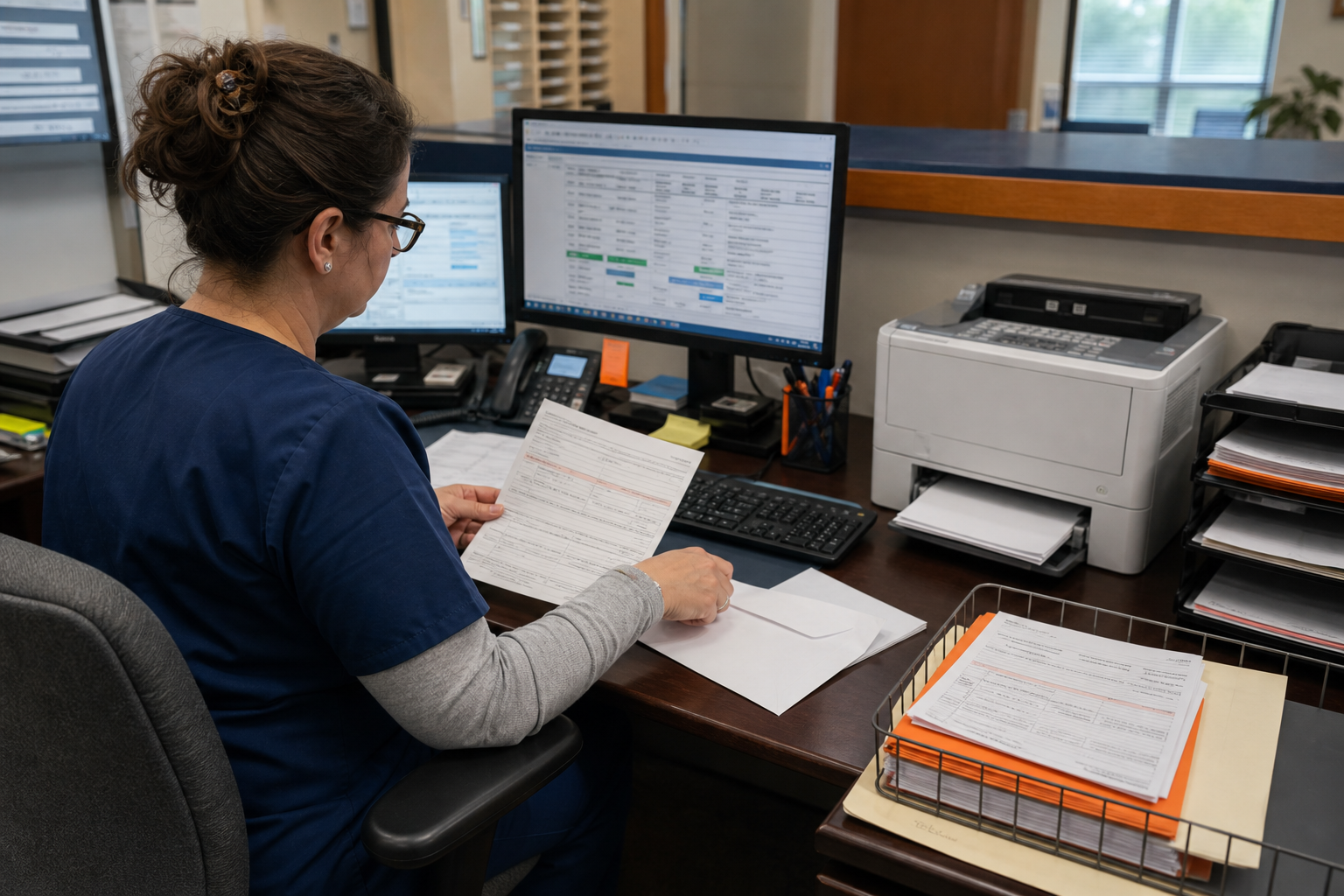
Most modern billing systems center on electronic claims and can support paper exceptions, but practices should verify form generation, attachments, status tracking, mailing responsibility and reconciliation for both channels.
Electronic submission should be the primary workflow
Billing software normally creates a standard electronic transaction and sends it through a clearinghouse or directly to a payer. The system should capture acknowledgments and distinguish batch failures, claim-level rejections and later denials. Staff need queues that show the reason, owner and resubmission history.
CMS explains that electronic claims pass through standards, implementation-guide and payment-policy edits. A transmission confirmation alone does not prove successful adjudication.
Paper claims are usually an exception path
Some payer, claim or attachment situations may still require paper. Ask whether the software produces the appropriate professional or institutional form, aligns fields correctly and preserves the same claim record used for follow-up. The practice should know who prints, reviews, mails and records the submission date.
Do not create a second untracked process outside the billing system. Paper status, notes and responses should remain visible with electronic work.
Verify attachments and supporting records
Claims may require records, reports or other documentation. Ask whether electronic attachments are supported for the relevant transactions and payers and how paper attachments are associated with the claim. Users need a checklist that protects PHI and avoids sending unnecessary information.
Confirm mailing addresses, cover sheets and tracking methods through current payer guidance. Software can organize the task but may not maintain every payer exception automatically.
Control duplicate and corrected submissions
When users switch between electronic and paper channels, duplicate submission risk increases. The system should show prior transmission, payer response and the reason for resubmission. Corrected claims need the appropriate indicator and reference information rather than being sent as a new claim without context.
Define who authorizes a channel change. Review duplicate denials and repeat submissions as a process metric.
Reconcile responses regardless of channel
Electronic acknowledgments arrive quickly, while paper responses may appear through portals, mail or remittance. Staff should record each response and next step in the same account history. Aging reports must not treat a mailed claim as untouched simply because no electronic status exists.
Payment posting and deposit reconciliation should work the same way once the payer adjudicates. Preserve the remittance and supporting notes.
Price the paper workflow realistically
Paper claims can create printing, postage, handling and staff-review costs. Some vendors or clearinghouses charge per mailed claim. Ask whether those fees are included and how returned mail or rejected forms are handled. Estimate volume from recent history rather than assuming paper never occurs.
Compare total transaction charges with the base software subscription and interfaces.
Document the exception rules for staff
Create a short procedure that identifies when paper is allowed, who verifies the form, how attachments are protected, where mailing evidence is recorded and when follow-up begins. Review the list against current payer instructions instead of relying on staff memory. A controlled exception path reduces duplicate submissions and helps a backup employee continue the work.
Include returned mail and address corrections in the same procedure. These are operational tasks, not reasons for a claim to disappear from aging. Periodically sample mailed claims against the system record and payer response so managers know the exception process is actually being followed.
Demonstrate a complete paper exception before buying
Ask the vendor to create a representative paper claim, attach supporting information, record mailing and show follow-up in aging. Then demonstrate the equivalent electronic claim and acknowledgment. The difference should be controlled and visible.
Review medical billing software options and use the medical billing prices form for a full comparison. The right platform handles electronic volume efficiently without letting necessary paper exceptions disappear.